I applied for a technical writer role focused on writing documentation, which is exactly what the posting described and what I had prepared for. Then the interview process ended with a case study about release notes.
They gave me a scenario and a handful of sample release tickets, and asked me to present how I’d handle documentation for a weekly release cycle. The scenario was deliberately messy, in a way anyone who has worked near docs in tech will recognize: vague tickets, late changes, shifting scope and writers doing their own discovery because nobody hands them a clean spec.
Release notes had come up earlier in the process, but between a terrible ear infection, antibiotics and general nerves, I never registered how central they were to the role. The case study made two things clear at once. This job involved far more release note work than I’d realized, and I was about to present on a document type I had almost no experience with.
Everything was locked
My usual interview prep is pretty straightforward: I read the company’s documentation and release notes, then sign up for a trial account and run a few real tasks in the product. You can’t talk credibly about documentation for something you have never touched.
None of that was available to me here. There were no public docs, no release notes I could find anywhere and no self-serve trial, because this is enterprise software and enterprise software doesn’t hand out accounts to job candidates. I went looking at their competitors just to understand the shape of the category and hit the same wall.
So what exactly was I applying to?
I ended up on YouTube watching interviews with their CEO and on LinkedIn reading everything I could find about the company and the people in it. Doing your homework on a company you can’t see much of from the outside is worth it before you spend a week building a presentation for them.
Then it hit me: my preparation had turned into the case study itself. I was being asked to plan documentation for a weekly release cycle using incomplete inputs and my own discovery, and that was exactly what I’d just done to figure out what the product even was.
That changed how I approached the presentation. I couldn’t win this on release note experience I didn’t have, and pretending otherwise for 25 minutes in front of people who do this every week would never have survived the Q&A. What I could do was show them how I think.
What I pitched
I opened by reframing the problem, which felt risky but was the right call.
They’d described what could pass for a writing speed problem, a team short on staff. Releases ship weekly, the inputs are incomplete and the writing is a scramble. I framed inconsistent release communication as a reliability and trust problem instead, and the cost shows up in three places: users get confused, the team scrambles at the last minute and support debt piles up. When release notes and product behaviour don’t match, people stop trusting the docs and contact support instead, and every avoidable support contact costs real money. That makes consistent documentation a deflection mechanism rather than a nice-to-have.
Then I proposed a new workflow that starts with engineers adding a few lightweight tags to their tickets to signal what’s coming: customer-facing or internal, behaviour change or cosmetic, global rollout or feature flag. Writers use those signals to triage by user impact, visibility, support debt risk and business risk. High-priority items move into a structured first draft built on the existing release note format, while everything else queues in its own funnel for the next pass.
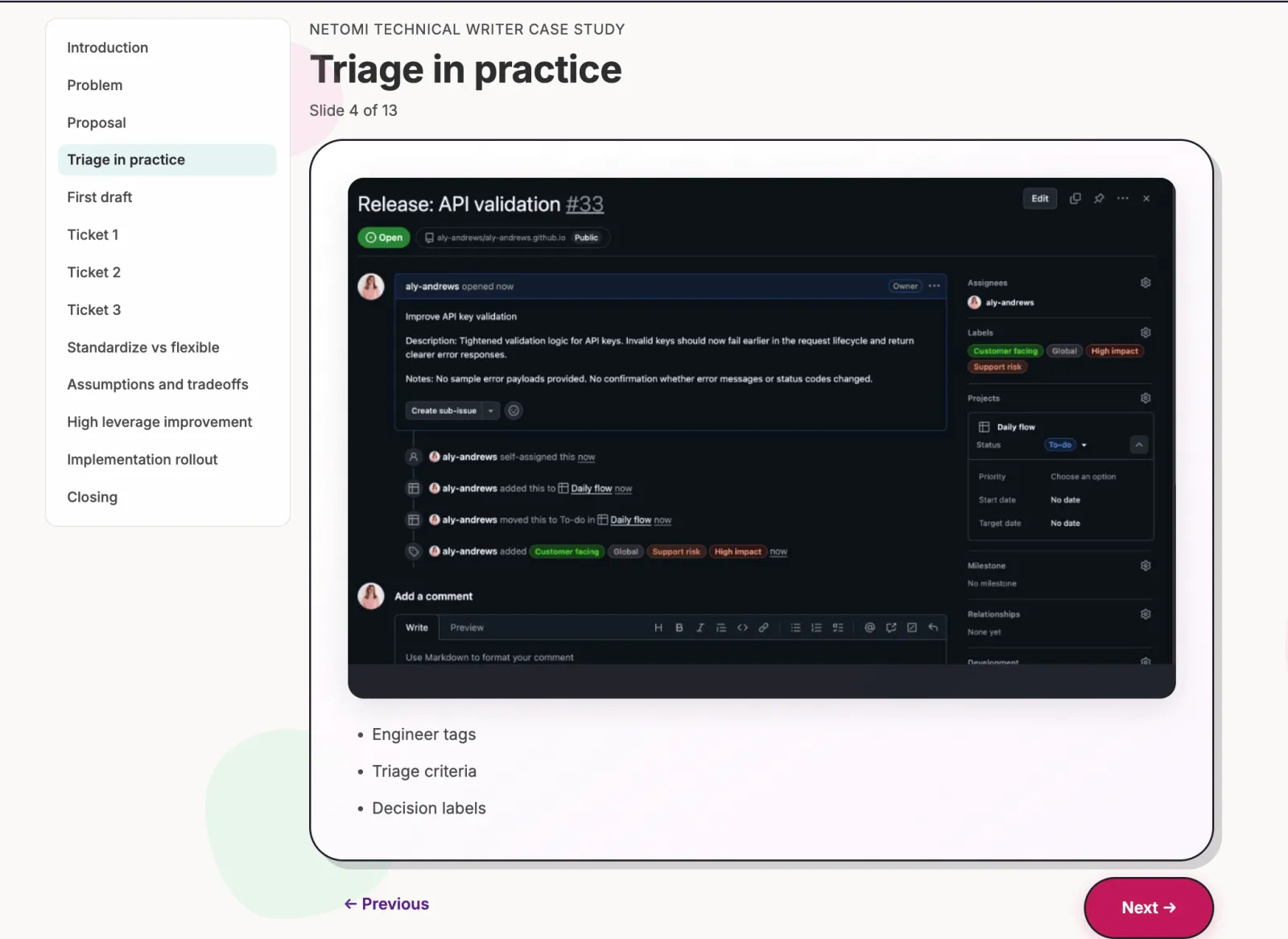
The writers stay the gatekeepers, and nothing publishes automatically. The goal was never to generate finished content; it was to shorten the distance between a closed ticket and a usable first draft for the tickets with the highest customer impact.
There was one line in the deck I was proudest of.
Structured content now is training data later.
Do the tagging manually this quarter and you’ve built the dataset that lets you automate the triage next quarter. The rules for deciding what gets documented don’t change, only how fast they’re applied.
I was also careful to say what I wasn’t proposing. This isn’t a redesign so much as a few small additions to a process that already works. The tradeoff is real work upfront, and it only pays back because the process repeats every single week.
Then the questions started
The sample tickets were where it got interesting, because every one of them was missing something.
One had tightened validation logic with no sample error payloads and no confirmation of whether the status codes had changed. I said I’d publish the confirmed behaviour immediately, because authentication problems block real work and people need to know now, and I’d explicitly flag the payload details as pending rather than guess at them. Clear guidance now, complete detail shortly after.
One was a settings toggle sitting behind a feature flag with no screenshots. I’d publish what users need to act on, add explicit rollout caveat language so nobody panics when they can’t find the setting, and hold the screenshots until the interface is stable enough to be worth capturing.
One was an internal refactor that engineering considered invisible. I’d document it internally, verify with engineering rather than taking “no functional changes” at face value, and promote it to customer-facing the moment any user-visible behaviour turned up.
Then the Q&A got specific: deeply technical, highly detailed and well past what a week of preparation had given me.
I don’t know. Yet.
So I said so.
I didn’t say it as a confession or with an apology attached. I said, in effect, “I don’t know that yet, here’s how I’d find out and I’ll come back to you with an answer.”
The exercise was explicitly built around incomplete information. The whole point was to see how somebody reasons when the inputs are bad. If I’d bluffed my way through a question about error payloads I didn’t have, I would have demonstrated the exact behaviour that makes documentation dangerous. Confidently wrong is so much worse than openly unfinished. A writer who guesses at a status code because admitting uncertainty feels bad is a writer who will publish something a customer builds against and gets burned by.
Saying “I don’t know yet” in an interview is the same instinct as flagging a pending confirmation in a release note instead of filling the gap with something plausible, and both of those are the job working correctly rather than a hole in it.
What they were actually hiring
They weren’t hiring for release notes experience. If they had been, I’d have lost to almost anyone, and the posting would have said so.
They were hiring judgment under ambiguity, which is something you can demonstrate in a presentation about a problem you’ve never personally solved. Delivery, structure, prioritization, the ability to say why one ticket matters more than another and defend it. Release notes are a skill, and skills are learnable in a way that judgment isn’t.
So I got the job on a pitch for a process I hadn’t built yet, at a company whose product I’d never used, writing a document type I’d never written.
And then I had to go and build it.