The pitch
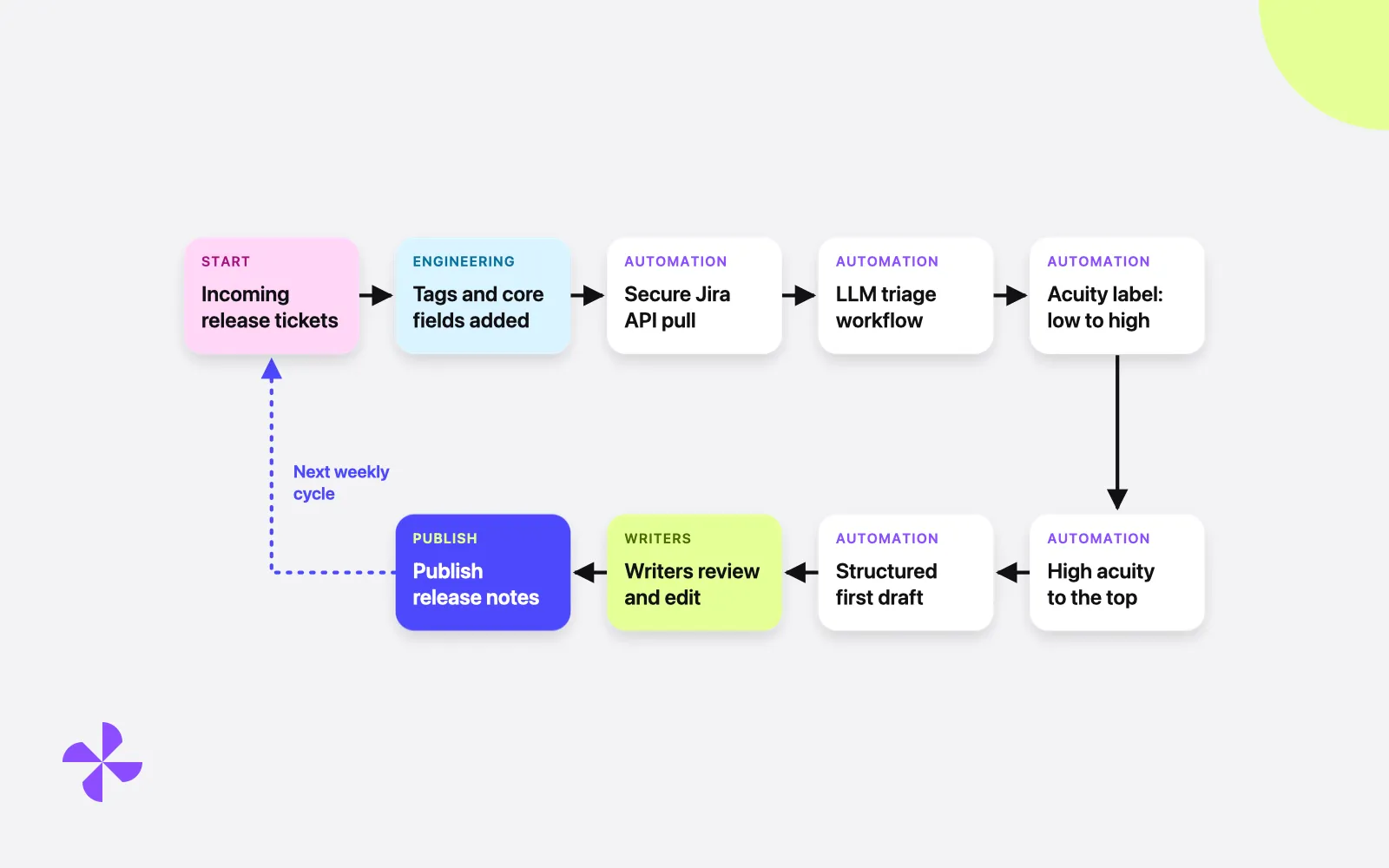
The interview process at Netomi ended with a case study about release notes. I reframed what looked like a writing speed problem as a reliability and trust problem, and proposed a workflow where engineers tag their tickets and writers triage by user impact before anything gets drafted. The writers stay the gatekeepers and nothing publishes automatically.
This is the workflow I proposed:
Read the full story in “I don’t know, but I’ll find out”
The build
Fast-forward to my first few weeks at Netomi as their newest Technical Writer. I jumped straight into the deep end to start building the new workflow I’d pitched only a few weeks earlier.
I ended up building a Claude-powered release notes pipeline from scratch, and it is not the workflow I pitched. I wrote the pitch from a scenario and a handful of sample tickets that did not come anywhere near the complexity of a real Jira ticket. The complexity of the product changed the scope, so once I was working inside a real weekly release cycle, the design changed.
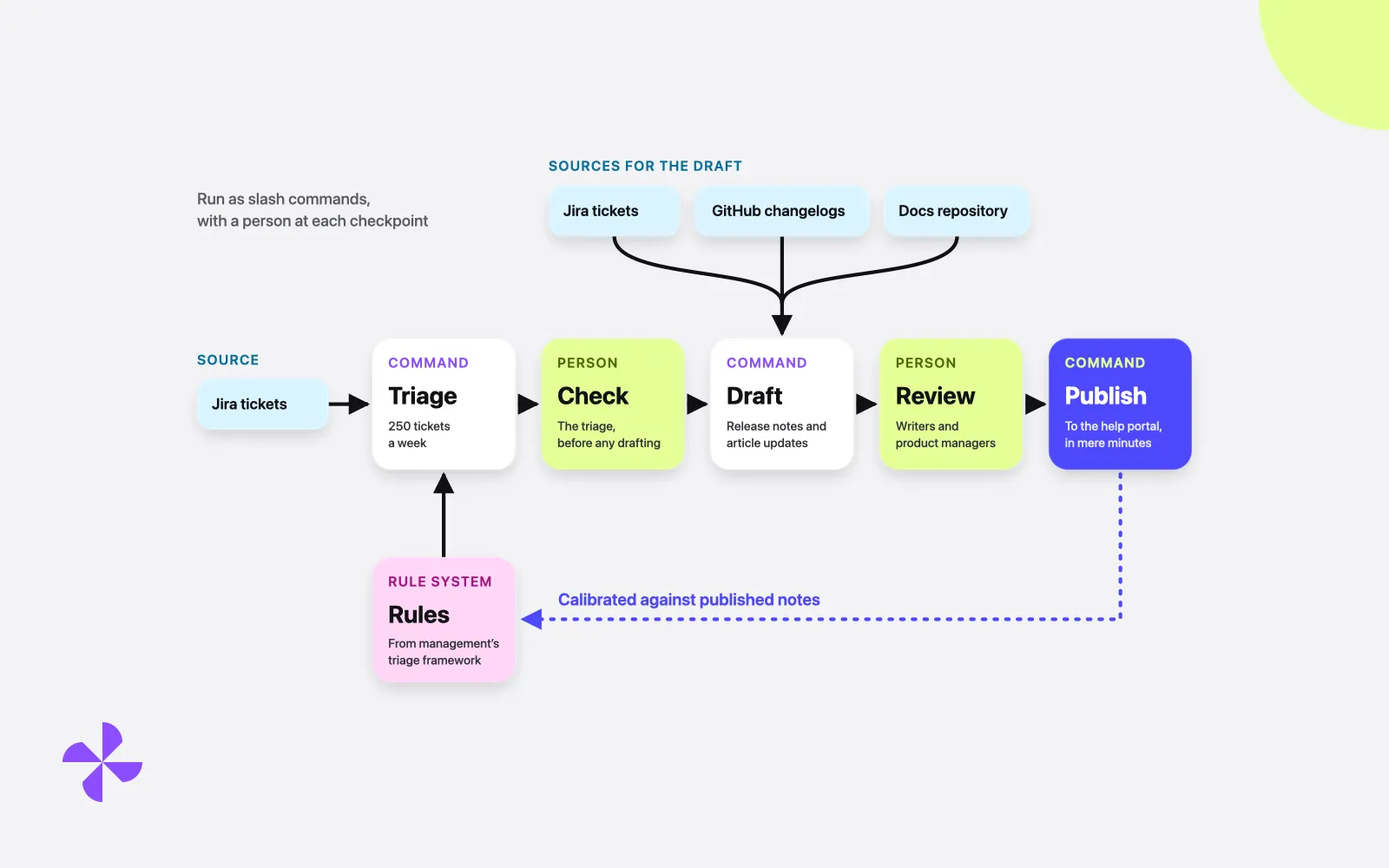
This is the pipeline as I built it:
What changed between the pitch and the build:
- More sources, at the draft. The pitch pulled everything from Jira tickets. The real pipeline still triages from the Jira tickets alone. The draft is where it brings in all three sources, the tickets, GitHub changelogs and the docs repository, to create an accurate release note.
- Rules in place of scores. The pitch had writers triage by hand first, then a model label each ticket low, medium or high once the tagged data existed. The pipeline is driven by an explicit rule system. I built the rules from 1:1 transcripts that captured management’s triage framework. My manager knew I was recording those conversations for exactly this purpose. This was a goldmine of institutional knowledge only an OG would know, and I turned that into actionable data.
- Checked against real output. I calibrated the output against release notes that had already been published. Recall went from 45% on the first dry run to 95% on the first live weekly run. Every iteration only improved from there.
- Two kinds of draft. The pitch ended with a first draft of the release notes. The pipeline drafts release notes and updates to the help articles that each release note affects.
- People run it. Every workflow is transferable. Teammates run them as slash commands with human-in-the-loop checkpoints, from a shared repository and a custom onboarding plan.
The impact
The pipeline triages 250 engineering tickets a week. The time from release pull to review-ready drafts went from three days to one.
I presented the automation to VP leadership. Product leadership adopted my guide as the wider team’s standard starting point for Claude Code.
Within two months I was able to independently own the documentation release cycle, from triage and PM review to publishing across internal, external and partner portals.
More than release notes
The pipeline I created is far more than the release notes. It acts as an automation branch to fuel other tasks.
- Article drafts. The pipeline includes the drafts of the help article updates.
- The HTML converter. It then feeds the HTML converter, which turns the drafts into the HTML our help portal expects.
- The product deck. The release note output becomes the source of truth for the customer-facing product deck. It answers two questions: what do clients need to know and what matters most right now. Then it presents the answers visually, value first.
When I shared my project and updates, the question I got the most was “But how did you do that? Where do you even start?”
Publishing in mere minutes
The last step turns the reviewed release notes and article updates into the HTML RoboHelp needs for our help portal. Publishing the weekly release used to take a solid day by hand. Now a teammate runs it as a slash command and it takes minutes.
Read how the converter started in “Same concepts, different tool”
The wrap-up
I pitched a release notes workflow from a scenario and a handful of sample tickets. What I actually built triages the tickets, drafts the release notes and the article updates, publishes them and feeds the product deck.
The design changed. The thinking behind it didn’t. It was never a speed problem. It was a reliability and trust problem, and there is still a person at every checkpoint.